What payment methods do you accept
Chimpanzee Civil War in Kibale National Park points
Tree Climbing Lions of Ishasha: A Detailed Guide to One of Uganda’s Most Remarkable Wildlife Experiences
Few wildlife encounters in Africa are as intriguing as seeing a lion resting high above the ground in the branches of a tree. In Uganda, this extraordinary behavior is particularly associated with the Ishasha Sector of Queen Elizabeth National Park, where visitors have the opportunity to search for lions lounging in large fig trees and other suitable trees across the savannah.
Ishasha is located in southwestern Uganda, close to the border with the Democratic Republic of the Congo. The area is known for its remote wilderness, expansive grasslands, woodland, rivers, and diverse wildlife. While Queen Elizabeth National Park is famous for its elephants, hippos, buffaloes, Uganda kob, leopards, lions, chimpanzees, and the spectacular Kazinga Channel, Ishasha has developed a special reputation because of its unusual tree-climbing lions.
For travelers planning a Uganda safari, an encounter with these lions offers much more than a photograph. It provides an opportunity to observe wild lions in a distinctive environment and to appreciate the fascinating behavioral diversity of one of Africa’s most iconic predators.
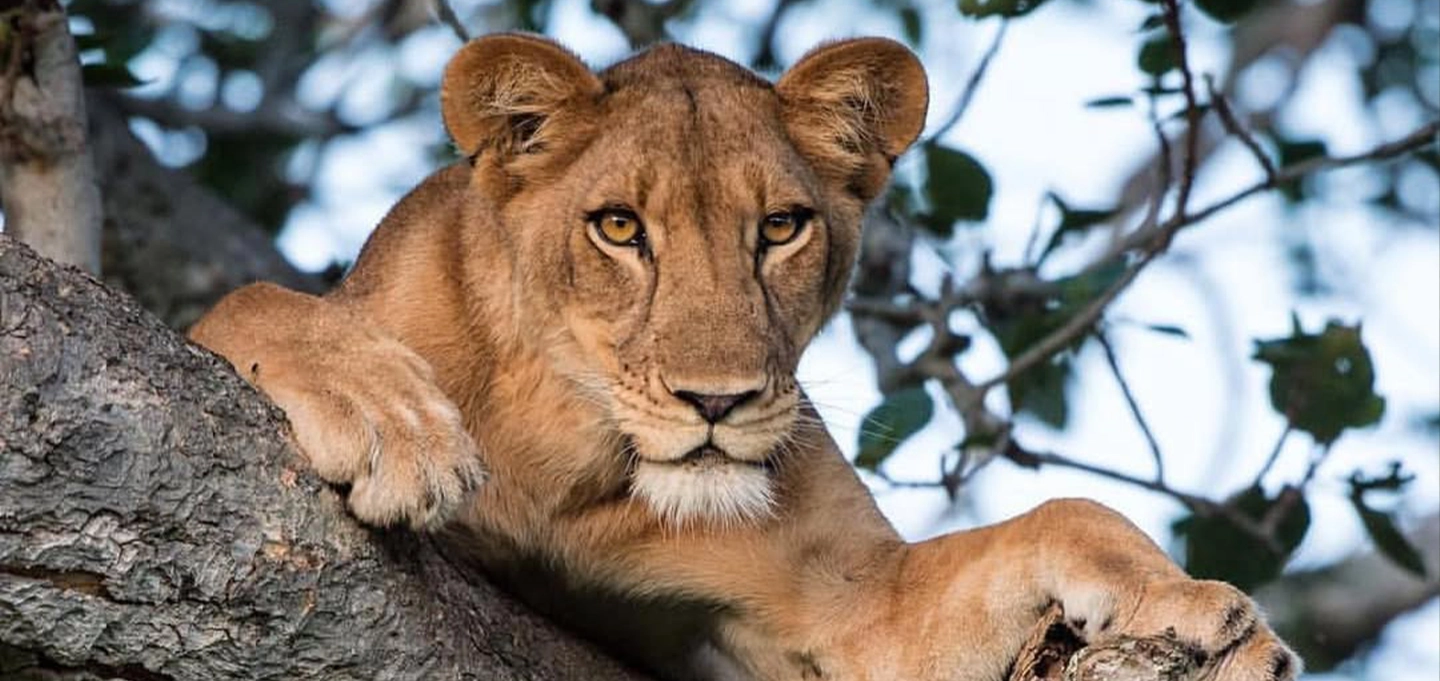
Tree-climbing lions resting high in the branches of a fig tree in Ishasha, one of Uganda’s most remarkable wildlife experiences.
Where Is Ishasha and Why Is It Special?
The Ishasha Sector forms the southern part of Queen Elizabeth National Park. It is considerably more remote and less developed than some of the park’s better-known tourism areas, giving it a strong sense of wilderness.
The landscape is characterized by open savannah, scattered trees, woodland, riverine vegetation, and seasonal water sources. This combination provides habitat for a wide range of wildlife and creates an ideal environment for predators and their prey.
One of the most distinctive features of Ishasha is its population of lions that are frequently observed climbing trees. While lions elsewhere in Africa may occasionally climb trees, the repeated observation of this behavior in Ishasha has made the area particularly famous among wildlife enthusiasts and photographers.
The remoteness of Ishasha is also part of its appeal. A game drive here can feel very different from visiting a heavily concentrated wildlife-viewing area. You may spend time quietly driving through the savannah, watching antelope and birds, before suddenly discovering a pride of lions resting in a tree.
Why Do the Lions of Ishasha Climb Trees?
One of the most frequently asked questions about the Ishasha lions is simple: Why do they climb trees?
There is no single explanation that has been conclusively established for every tree-climbing lion. Instead, wildlife researchers and observers have proposed several possible benefits associated with the behavior.
The reasons may also vary depending on the time of day, weather conditions, insect activity, social circumstances, and the individual lion.
Escaping the Heat
One possible advantage is relief from the heat.
During the hottest part of the day, temperatures across the open savannah can become uncomfortable. A lion resting directly on the ground may experience heat radiating from the soil and vegetation.
A tree branch can provide shade, while air movement higher above the ground may help make the environment more comfortable.
This may explain why visitors sometimes encounter lions stretched across branches during periods when the animals would normally be resting.
Lions are energy-efficient predators. They spend considerable portions of the day resting and conserving energy for periods of activity, particularly hunting. Finding a comfortable elevated location can therefore be an important behavioral advantage.
Avoiding Insects
Another commonly suggested explanation is that climbing trees may help lions avoid or reduce contact with biting insects.
Savannah environments can contain numerous insects, including flies and other biting species that may bother large mammals. Staying above the ground may provide some relief, particularly when insect activity is high.
This explanation is often mentioned when discussing the tree-climbing behavior of Ishasha’s lions, although it should be treated as a possible benefit rather than a definitive scientific explanation.
Wildlife behavior is rarely governed by one factor. A lion may climb a tree because it provides shade, reduces insect disturbance, offers a comfortable resting location, and provides an excellent view of the surrounding landscape all at the same time.
A Strategic View From Above
Another fascinating possibility is that trees provide lions with a better vantage point.
From the ground, vegetation and uneven terrain can limit visibility. From an elevated branch, a lion may be able to observe a much wider area.
This can potentially help the animal monitor:
- Other members of its pride
- Potential prey
- Other predators
- Human activity
- Changes in the surrounding environment
Lions are visual hunters, and having a higher viewpoint can provide an interesting advantage.
For safari travelers, this behavior also creates an extraordinary viewing experience. Instead of seeing a lion lying beneath a tree, visitors may look upward and discover an entire animal comfortably positioned among the branches.
What Trees Do the Lions Prefer?
The trees associated with the Ishasha lions are particularly important because a mature lion is a large and heavy animal.
Large fig trees with sturdy, low branches can provide suitable platforms for these animals. The branches must be strong enough to support the lion’s weight and positioned in a way that allows the animal to climb and settle comfortably.
The shape of these trees also contributes to their usefulness. Broad branches can provide shade and enough space for a lion to stretch out.
For wildlife photographers, these trees create one of the most distinctive compositions in Uganda: a powerful African lion resting among green foliage against the backdrop of the savannah.
Are Ishasha’s Lions a Different Type of Lion?
No. The tree-climbing lions of Ishasha are not a separate species or officially recognized subspecies simply because of their unusual behavior.
They are African lions, scientifically known as Panthera leo.
Their uniqueness lies primarily in their behavior and the frequency with which tree climbing is observed in the area.
Tree climbing itself is not completely unknown among African lions. However, it is relatively unusual compared with the more typical behavior of lions spending most of their time on the ground.
This is one reason Ishasha has become such an interesting destination for wildlife researchers, photographers and safari travelers.
Understanding the Social Life of Ishasha Lions
A lion sighting becomes even more fascinating when you understand the social structure of the species.
Unlike many other large African predators, lions are highly social. They commonly live in groups known as prides, although the exact composition and size of a pride can change over time.
A pride may include females, cubs, and males, depending on the social circumstances.
Female lions often form the core of the pride and may have strong relationships with other females. They can cooperate in raising cubs, defending territories and, under certain circumstances, hunting.
Males also play an important role in pride dynamics, particularly in territorial defense and reproduction.
Therefore, when visitors see several lions resting together in or around a tree, they are witnessing more than a collection of individual animals. They may be observing members of a complex social group interacting and maintaining relationships.
Playful Lion Cubs and Family Bonds
If you are fortunate enough to encounter cubs in Ishasha, the experience can be especially memorable.
Young lions spend considerable time learning through play. Play can involve chasing, wrestling, stalking, pawing, jumping and interacting with other members of their group.
These behaviors are not simply entertainment. Play can help young lions develop coordination, physical strength, hunting skills and social awareness.
Watching lion cubs interact with one another can therefore provide an insight into how young predators prepare for adulthood.
For photographers and families traveling on safari, these moments can also be among the most emotionally engaging wildlife encounters.
Lions and Their Role in the Ecosystem
Lions are apex predators and play an important role in maintaining ecological balance.
They prey on a variety of animals, including antelope and other large herbivores. By participating in predator-prey relationships, lions contribute to the complex natural processes that regulate wildlife populations.
Their presence is also an indicator of a functioning ecosystem.
A healthy lion population requires more than protection from direct threats. Lions need adequate prey, suitable habitat, access to water, space for territories, and a relatively secure environment.
This means that protecting lions also requires protecting the broader ecosystem in which they live.
What Other Wildlife Can You See in Ishasha?
One of the biggest mistakes a visitor can make is to think that Ishasha is only about tree-climbing lions.
The sector offers an impressive range of wildlife.
During a game drive, you may encounter:
- African elephants
- African buffaloes
- Uganda kob
- Topi
- Antelopes
- Warthogs
- Hippos
- Leopards
- Various monkey species
- Numerous bird species
The exact wildlife encountered will depend on the season, weather, time of day and animal movements.
This unpredictability is part of what makes a safari exciting. You are entering a natural ecosystem rather than a controlled wildlife attraction.
Ishasha and the Broader Queen Elizabeth National Park Experience
Ishasha becomes even more attractive when incorporated into a broader Queen Elizabeth National Park itinerary.
The northern and central areas of Queen Elizabeth offer different wildlife experiences, including game drives across the Kasenyi Plains and boat cruises along the Kazinga Channel.
The Kazinga Channel is famous for its concentration of hippos, crocodiles, elephants, buffaloes and waterbirds.
Combining these experiences with a visit to Ishasha can provide a more comprehensive understanding of the park’s biodiversity.
A traveler might begin the safari with traditional savannah game drives, continue toward Ishasha to search for tree-climbing lions, and then enjoy a boat cruise where wildlife can be observed from the water.
The Importance of Conservation
The popularity of Ishasha’s lions is closely connected to the broader challenge of conserving lions and their habitats.
Across Africa, lions face several threats, including habitat loss, reduced prey availability, human-wildlife conflict, retaliatory killing, disease, snares and other pressures.
Conservation therefore requires more than simply protecting lions inside national parks.
It also involves maintaining healthy prey populations, reducing illegal activities, supporting surrounding communities, protecting wildlife corridors and ensuring that tourism contributes positively to conservation.
Uganda’s protected areas play an important role in safeguarding the country’s remaining wildlife populations.
How Tourism Supports Wildlife Conservation
Responsible tourism can contribute to wildlife conservation in several ways.
Park fees, tourism activities, accommodation, guiding services and other safari-related businesses contribute to an economic system that makes wildlife protection valuable.
Tourism also creates employment opportunities for guides, drivers, lodge staff, conservation workers and communities around protected areas.
When visitors come to Uganda specifically to experience wildlife, their spending can help demonstrate the economic importance of maintaining healthy ecosystems.
For this reason, choosing responsible safari operators and following park regulations is an important part of supporting conservation.
Responsible Viewing of Tree Climbing Lions
Seeing a lion in a tree can be exciting, particularly when the animal is positioned perfectly for photography. However, responsible wildlife viewing should always come first.
Visitors should:
- Follow instructions from their safari guide.
- Maintain an appropriate distance from wildlife.
- Avoid shouting or making unnecessary noise.
- Never attempt to attract a lion’s attention.
- Avoid feeding or interacting with wild animals.
- Respect park regulations.
- Allow animals to behave naturally.
A great wildlife photograph is one that captures a genuine natural moment without disturbing the animal.
Photography Tips for Tree Climbing Lions
Ishasha provides exceptional opportunities for wildlife photography.
A lion positioned on a tree gives photographers an unusual composition because the animal is elevated above the normal safari landscape.
When photographing these lions, consider the entire scene rather than focusing only on the animal.
Including branches, leaves, sky and savannah in the frame can help communicate the uniqueness of the encounter.
Early morning and late afternoon can also provide softer natural light, although wildlife sightings cannot be guaranteed at any particular time.
A telephoto lens can be particularly useful because it allows you to capture detailed images without getting unnecessarily close to the animal.
When Is the Best Time to Visit Ishasha?
Ishasha can be visited throughout the year, but wildlife experiences can vary depending on seasonal conditions.
During drier periods, wildlife may become easier to locate around water sources and open areas. Roads may also be easier to navigate.
During wetter periods, the landscape can become exceptionally green and scenic, and migratory or seasonal bird activity can increase.
However, there is no season that guarantees a tree-climbing lion sighting.
These are wild animals, and their behavior changes naturally.
The most important factor is therefore not simply choosing a particular month but allowing enough time in the area and working with experienced guides who understand the landscape and recent wildlife movements.
How Long Should You Spend in Ishasha?
The amount of time you should spend in Ishasha depends on your overall Uganda safari itinerary.
A single game drive can provide an opportunity to search for the famous lions, but spending longer in the area gives you more opportunities to observe wildlife under changing conditions.
For travelers combining Ishasha with gorilla trekking, it can be particularly convenient to incorporate the sector into a route between Queen Elizabeth National Park and Bwindi Impenetrable National Park.
This creates an exciting transition from savannah wildlife to the misty forests of southwestern Uganda.
Combining Tree Climbing Lions With Gorilla Trekking
One of the strongest reasons to visit Ishasha is its potential to complement a gorilla trekking adventure.
Imagine beginning your journey in the savannah, watching elephants and buffaloes, searching for lions resting in fig trees, and then continuing toward Bwindi to trek through ancient rainforest in search of mountain gorillas.
These experiences showcase two dramatically different sides of Uganda’s natural heritage.
A combination of Ishasha wildlife viewing and Bwindi gorilla trekking can therefore create a particularly memorable Uganda itinerary.
Combining Ishasha With Chimpanzee Trekking
Travelers interested in primates can also combine Ishasha with chimpanzee trekking in Uganda.
Kibale National Park is renowned for its chimpanzee population and offers a very different wildlife experience from the open savannahs of Queen Elizabeth National Park.
A multi-destination itinerary can therefore include:
Kibale → Queen Elizabeth → Ishasha → Bwindi
This route allows travelers to experience chimpanzees, savannah wildlife, tree-climbing lions and mountain gorillas within one extended Uganda adventure.
The exact routing should be customized according to travel dates, available time, accommodation preferences and trekking permit availability.
Why Tree Climbing Lions Make Ishasha Unique
There are many places in Africa where travelers can see lions.
What makes Ishasha special is the possibility of seeing these powerful predators in an unusual setting.
A lion stretched across a tree branch challenges the traditional image of the species. Instead of seeing the animal stalking through grassland or resting beneath a tree, you may find it several meters above the ground, completely relaxed.
It is an encounter that combines wildlife behavior, photography, landscape and conservation into one experience.
Planning Your Ishasha Safari With Tukumbe Tours & Travel
At Tukumbe Tours & Travel, we can help travelers design customized Uganda safari itineraries that include the Ishasha Sector and other major wildlife destinations.
Depending on your interests and available time, your itinerary can include:
- Tree-climbing lion viewing in Ishasha
- Queen Elizabeth National Park game drives
- Kazinga Channel boat cruises
- Gorilla trekking in Bwindi
- Chimpanzee trekking in Kibale
- Golden monkey experiences
- Birdwatching
- Cultural experiences
- Scenic journeys through southwestern Uganda
We can also help coordinate transportation, accommodation, park activities and other logistical elements of your safari.
The goal is to create an itinerary that matches your interests rather than simply following a standard route.
Final Thoughts: Discover the Lions Above the Savannah
The tree climbing lions of Ishasha are among Uganda’s most fascinating wildlife attractions.
Their unusual behavior offers a reminder that wildlife is full of surprises. Even an animal as familiar as the African lion can display behaviors that challenge our expectations and provide new opportunities for observation and discovery.
Ishasha is more than a destination for finding lions in trees. It is a wilderness landscape where predators, herbivores, birds, forests and savannahs interact as part of a larger ecosystem.
For travelers searching for an authentic Uganda wildlife safari, Ishasha offers the possibility of an unforgettable encounter—one where you may look into the branches of a giant fig tree and discover the unmistakable face of an African lion looking back at you.
Request for A Free Trip Quote
We’d be delighted to help you plan your dream Uganda Gorilla Safari. Simply fill out the inquiry form below, and one of our safari specialists will get back to you with a personalized quote and expert travel advice.
For direct assistance, feel free to contact us by email at info@tukumbetours.com or connect with us on WhatsApp at +256752294116. We look forward to creating an unforgettable African adventure for you